Astra Novae Pangaeae: accessibilia, rotantia, illuminantia. Technologia servit contemplationi; humanitas et caelum in harmonia permanent [Latin] - Stars of New Pangea: accessible, rotating, illuminating. Technology serves contemplation; humanity and the heavens remain in harmony
To stand in the cupola and watch the Earth turn beneath you is not escape from the world. It is the deepest possible return to it—seeing at last the single, fragile, living whole we have always belonged to. - Director of the Laurasia Programme, Opening Address, Station One, 2091
Public Access to the Heavens in New Pangea
Space travel in New Pangea was never framed as an elite adventure or a military frontier. From the earliest planning documents of the Ministry of Orbital Affairs it was treated as an extension of the same principles that guided the terrestrial redesign: equity of access, technology in service of life and understanding, and a deliberate refusal to export the old extractive mindset beyond the atmosphere. The result is a public programme that, within a few decades of the Revolution, became one of the quiet cornerstones of post-revolutionary culture.
Prototype work had begun in the 2040s, while the Global Revolution was still unfolding. On Wednesday, 5 November 2075, the first completed station, Laurasia I, was formally commissioned in low Earth orbit. Public operations commenced in early 2076. At that time only a single habitat was available, and the waiting list stretched for years. Selection was carefully balanced by age, region, occupation, and personal statement so that no single demographic could dominate the early cohorts. Within five years nine additional stations had been placed into service. By the 2090s the network comprised more than thirty major habitats distributed across low Earth orbit, higher-inclination orbits, and a smaller number at the Earth-Moon Lagrange points. A parallel robot-staffed station, Gondwana, had launched alongside Laurasia in 2075 and specialised in microgravity manufacturing and research; the primary public experience, however, remained the human-centred Laurasia series.
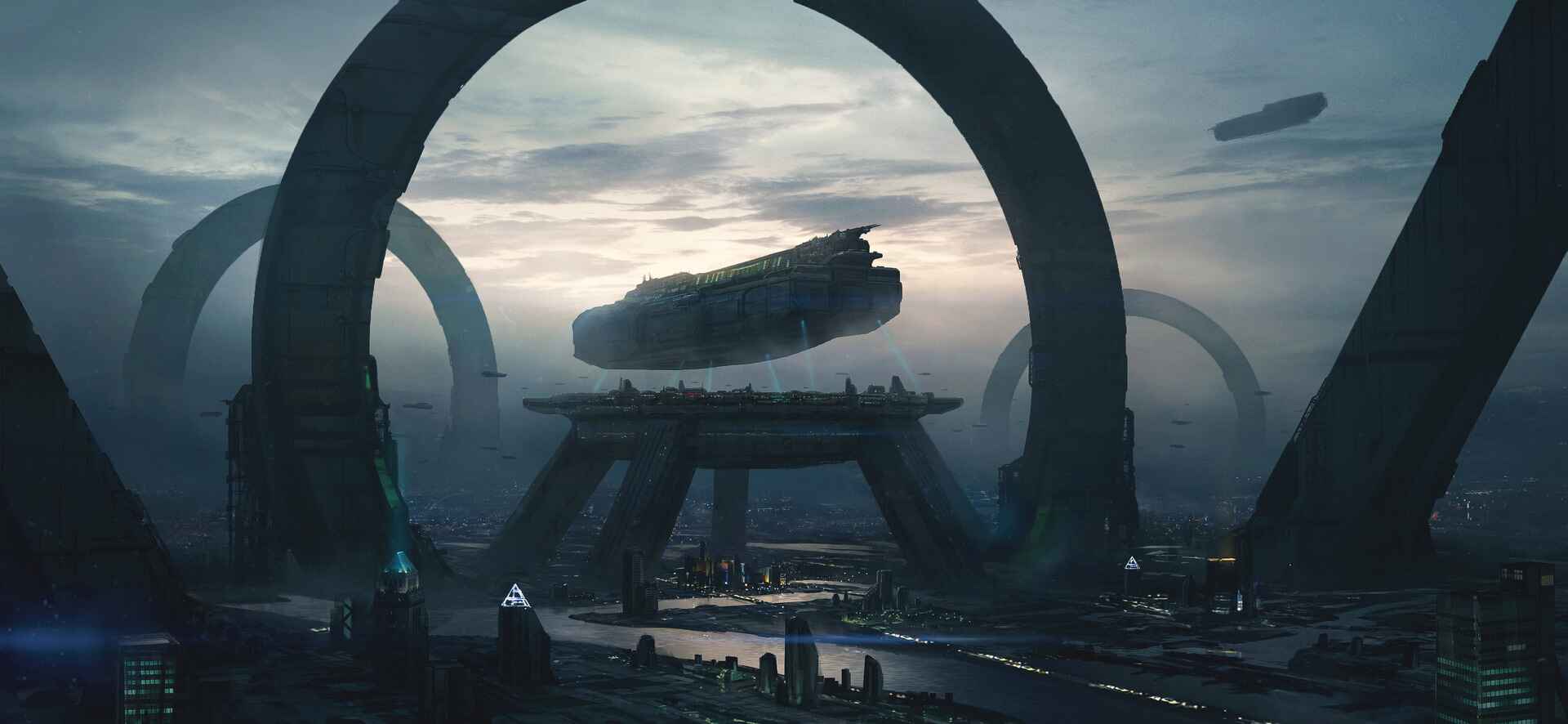
Station design reflects both engineering realism and the post-revolutionary aesthetic of restraint. Each major habitat is a large rotating torus or paired counter-rotating cylinders that provide comfortable artificial gravity in the outer residential and working rings—typically 0.8 to 0.9 g, sufficient to maintain bone and muscle health over a six-month stay. The central axis remains in microgravity and houses laboratories, observation cupolas, docking ports, and recreational zero-g volumes. Radiation protection combines water and residual-propellant shielding, advanced composites, and, in later stations, active magnetic deflection for solar-particle events. Closed-loop life support recycles air and water at efficiencies above 98 percent; food is supplied as a mixture of Earth staples and station-grown produce from high-intensity hydroponic and aeroponic gardens that also support psychological well-being.
The journey from surface to station has been normalised. Citizens travel first by the planetary maglev and ground-car network to one of several equatorial or near-equatorial spaceports. Ascent is provided by a mature fleet of fully reusable vehicles. Boarding feels closer to a sophisticated long-haul flight than to an expedition. After a brief period of microgravity acclimatisation, passengers dock with their assigned station and begin orientation. Most report that the psychological transition is more significant than the physical one: the sudden, continuous presence of the curved Earth, the absence of weather, the soft mechanical hum of a world that must manufacture all its own air and light.
Daily life aboard a Laurasia station is structured yet spacious. Residents are assigned private or shared quarters in the gravity ring, each with a window or high-resolution exterior feed. Communal areas include gardens, dining halls, libraries, workshops, and gymnasia designed for both gravity and microgravity exercise. The educational programme is extensive and voluntary. Formal courses cover orbital mechanics, Earth-system science observed from space, astronomy, closed-ecology engineering, and the history of the space age. Informal learning occurs constantly: watching weather systems evolve across continents, tracking the slow drift of the terminator, participating in citizen-science observations of atmospheric chemistry or marine bioluminescence. Many stations maintain research partnerships with surface institutions; a six-month resident may contribute data or analysis that feeds directly into planetary climate or biodiversity models.
Recreation takes forms impossible on the ground. Supervised zero-gravity sports include three-dimensional movement games, freestyle acrobatics, and water-based activities in spherical or cylindrical pools. Observation cupolas remain open at all hours; it is common to find residents simply sitting in silence, watching the planet turn. Cultural life flourishes as well: station choirs, theatre in varying gravity levels, and collaborative art projects that use the unique lighting and perspectives of orbit. Because the population of each station is deliberately mixed in age, origin, and background, social bonds form quickly and often endure long after return to the surface.
Health protocols are rigorous and transparent. Pre-flight screening identifies contraindications; countermeasures for bone density, cardiovascular deconditioning, and radiation exposure are built into daily routines. Psychological support is continuous and non-stigmatised. Return to planetary gravity is managed with a period of supervised readaptation. Longitudinal studies show that the great majority of residents experience lasting positive effects: a deepened sense of planetary identity, reduced tolerance for waste and conflict, and measurable increases in scientific literacy and civic engagement.
Expansion from one station to a full network required a parallel industrial ecology in orbit. Later habitats incorporated materials processed in space—lunar regolith refined into structural elements, asteroid-derived volatiles, and recycled components. The same closed-loop thinking that governs life support was applied to construction: minimising the mass lifted from Earth and treating the space environment as a place to be inhabited carefully rather than conquered. No station is permanently occupied by a fixed crew; the continuous rotation of public residents keeps the culture of the network open and non-hierarchical.
Societal impact has been subtle yet pervasive. Generations who have spent half a year looking down on the thin blue atmosphere and the unbroken sweep of oceans and continents speak of an irreversible shift in perspective. Regional identities do not disappear, but they are placed inside a larger frame. Environmental policy debates on the surface frequently reference the view from orbit; educational curricula incorporate station-derived imagery and data as a matter of course. As capacity grew, the once multi-year waiting lists shortened, yet the sense of the experience as a civic rite of passage remains. Many citizens defer their residency until later in life; others go as young adults and return transformed.
Looking ahead, the Ministry continues measured expansion. Additional stations at Lagrange points offer longer-duration stays and clearer deep-space observing conditions. A small number of public lunar-surface habitats are in early testing, though these remain more specialised. Interplanetary travel for ordinary citizens is still approached with characteristic caution; the priority remains the perfection of the near-Earth public network rather than a premature race outward. Research into more efficient propulsion, improved radiation shielding, and fully regenerative life support continues under the same governing ethic: space is not an escape from responsibility on Earth, nor a new arena for old patterns of domination. It is an extension of the same project—making the conditions of life more equitable, more intelligent, and more beautiful.
In the end the Laurasia stations are less about leaving the planet than about seeing it clearly for the first time. Six months in orbit does not turn a citizen into an astronaut in the old heroic sense. It turns them into someone who has lived, for a season, as a temporary inhabitant of the sky, looking homeward. That experience, once the privilege of a handful of professional explorers, is now part of the common inheritance of New Pangea. Technology made the journey possible; the post-revolutionary settlement made it just. The heavens, at last, belong to everyone who wishes to visit them—and to return.